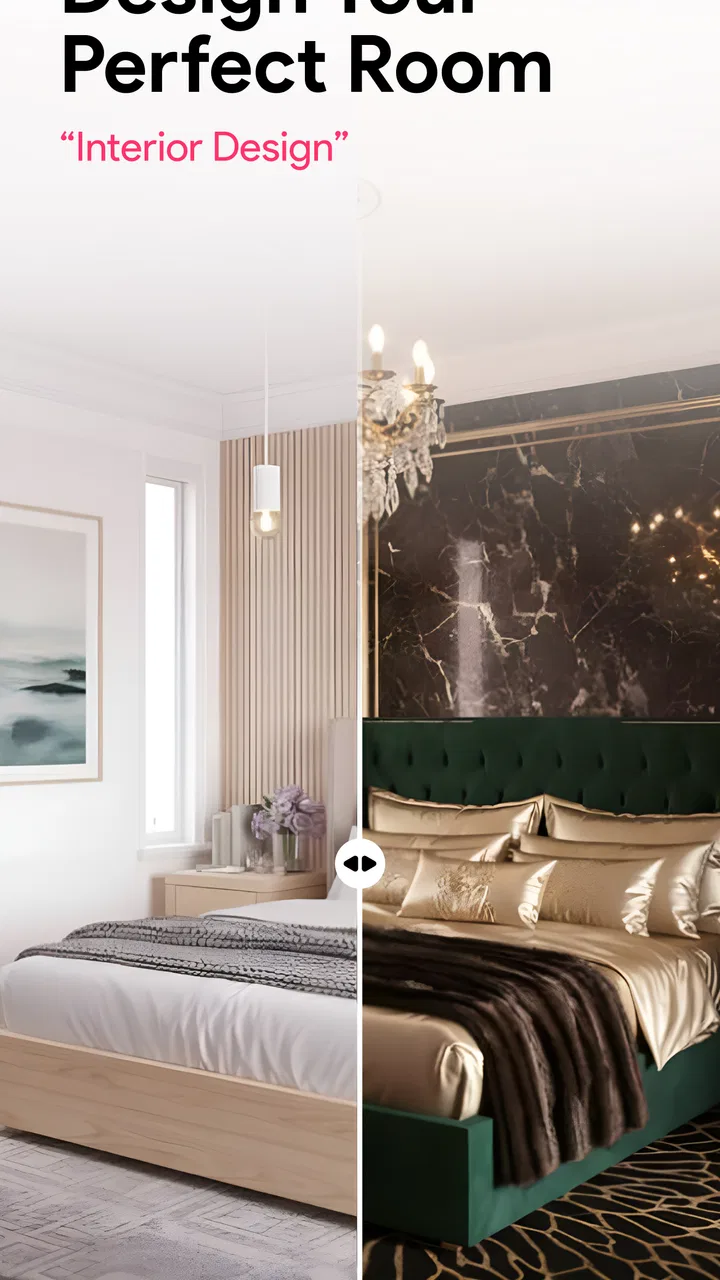
AI Room Planner: Home Design
- 4.3
- Rating
- 100.00K
- Installs
- Free
- Price

 Analysis by App-foxy
Redesigning a room usually starts with a vague feeling: the sofa looks wrong, the walls need a new color, or the garden could be much more inviting. AI Room Planner: Home Design is aimed at that early, uncertain stage. It is a free House & Home app from Hangover Studios that uses artificial intelligence to help turn interior, exterior, and garden ideas into visual concepts. I found its main value in making possibilities easier to discuss before spending money or moving heavy furniture.
The app is available to everyone and supports devices running Android 8.0 or later. Its current version is 14.0.0, and it has already passed the fifty-thousand-install mark with an average rating of 4.5 from roughly fifty ratings. Those figures suggest a small but positive user base rather than a long-established design platform, so I would approach it as a quick visualization tool, not as a complete replacement for professional planning software.
What I would consider before choosing it
My first decision criterion is the kind of answer I need. If I want inspiration for a living room, bedroom, patio, or garden, an AI visualizer can be much faster than collecting dozens of screenshots. If I need exact dimensions, a construction-ready plan, a materials schedule, or dependable lighting calculations, the category itself becomes less suitable. This app is strongest when the question is “What direction could work here?” rather than “What precisely should the contractor build?”
You May Also Like

 Blood Strike: 2.5 Anniversary
Blood Strike’s Loadouts Turn Every Drop Into a Tactical Gamble
A close look at Blood Strike’s custom loadouts: how fast access to signature weapons reshapes its battle royale rhythm, rewards preparation, and narrows the gap between fights.

 Pandora - Music & Podcasts
Pandora’s Music Is Easy to Start, but Harder to Recover
Pandora’s strength is its low-effort path from a seed to a station. Its weak spot is how much confidence it asks you to place in connection, setup, and quiet recovery.

 8 Ball Pool
 Is Built on Rivalries, Rematches, and Routine
A close look at the rivalries, rematches, shared routines, and unanswered safety questions that turn a quick pool match into a persistent mobile community.

 Samsung Music
’s Quiet Strength Is Playing What You Already Own
Its reach comes less from spectacle than from dependable access to a personal library. That simplicity is both the app’s strongest retention engine and its ceiling.

 AccuWeather: Weather Radar
AccuWeather Review: A Quick, Clear Forecast for Everyday Decisions
For everyday plans, the best forecast is the one you can understand quickly. AccuWeather makes rain timing, radar, and local conditions easy to act on, with a few trade-offs.

 Hill Climb Racing
Why Hill Climb Racing Still Turns Crashes Into One More Run
A tiny car, a bumpy hill and one more upgrade: Hill Climb Racing keeps resurfacing because its simple chaos makes every near-miss feel personal.
More From Our News Desk
View All News


The second criterion is how much effort I want to invest. Traditional room-planning tools often ask me to draw walls, enter measurements, place doors and windows, and build a room piece by piece. That approach can be accurate, but it also creates friction before I see anything interesting. An AI-based workflow is more appealing when I want to explore several moods quickly, especially during the first conversation with a partner or family member.
I would also think about how seriously I need to preserve the existing space. A generated concept can be persuasive while still being impractical. Furniture may appear in a different proportion, a walkway may become too narrow, or a garden idea may ignore drainage, shade, local weather, and maintenance. I treat every image as a design prompt that needs checking against the real room.
Finally, cost matters. The app is free to install, but in-app purchases range from $5.99 to $399.93 per item. That is a wide range, so I would not assume that every useful workflow is included at no cost. Before committing to a paid option, I would test the basic experience with a small project and decide whether its visual suggestions are genuinely helping me make a decision.
My first impression of the workflow
What makes this app approachable is the promise of moving from a real space to a more imaginative version of it without learning a full design program. I would begin with one area rather than trying to redesign an entire home. A single room gives the results a clear purpose and makes it easier to judge whether the generated direction respects the existing layout.
For a useful test, I would photograph the room in daylight, stand far enough back to show the main walls, and remove temporary clutter. This is not because the app replaces good photography, but because a clean reference gives me a better basis for comparing ideas. I would keep the same image while exploring different styles so that the changes are easier to evaluate instead of mixing improvements in the room with improvements created by the AI.
One practical habit is to separate “style” decisions from “layout” decisions. I would first explore colors, materials, and atmosphere. Only afterward would I consider whether a different sofa position, storage arrangement, or focal point makes sense. Combining every change at once can produce an attractive image that teaches me very little about which choice actually improved the space.
Where the visual approach is genuinely useful
The strongest use case is a household conversation. Imagine that I am preparing to refresh a tired living room, while another person in the home prefers something warmer and less minimalist. Describing those preferences can lead to an endless back-and-forth. A few visual concepts give us something concrete to compare: not a final commitment, but a shared vocabulary for discussing color, texture, openness, and mood.
I also see value for renters. A renter may not be able to change flooring or cabinetry, but can still explore furniture placement, wall color ideas, lighting mood, and decorative direction. The important discipline is to mark which elements are actually changeable. I would use the generated concept to identify affordable, reversible moves rather than copying every visible detail.
For someone preparing to sell a property, the app could help with presentation ideas. It may be useful for imagining a calmer, less personal look before photographing a room. I would still be careful not to treat the result as a promise to buyers. The image can suggest a staging direction, but it cannot confirm that the proposed furniture fits or that the renovation is financially sensible.
Garden and exterior concepts are another interesting area. A visual idea can help me decide whether I prefer a structured, low-clutter outdoor space or something softer and more planted. The hidden trade-off is that outdoor design depends heavily on conditions an image may not capture. I would use the app to choose an atmosphere, then separately check sunlight, water access, soil, plant suitability, and upkeep.
Three ways I would get more from it
My first tip is to use the app as a comparison instrument, not a one-image generator. I would create a small set of clearly different directions: for example, a lighter and airier option, a warmer version with stronger texture, and a more practical version focused on storage. Comparing distinct options makes the exercise more useful than repeatedly requesting tiny changes that are difficult to remember.
My second tip is to protect the non-negotiables. Before exploring, I would write down the features that cannot move: a radiator, a television connection, a dining table used every day, a pet’s feeding area, or a doorway that must remain clear. Generated designs often encourage visual drama, but a good home has routines. The best concept is the one that improves those routines rather than merely looking impressive in a single image.
My third tip is to turn an appealing image into a shopping filter. Instead of copying every object, I would identify the design principles behind it: perhaps fewer competing colors, more concealed storage, a lighter rug, or a stronger contrast wall. This approach reduces the risk of buying decorative items that do not solve the original problem. It also makes the app more useful when the available budget is limited.
A fourth useful habit is to keep a reality check beside each concept. I would note whether the idea requires painting, replacing furniture, moving electrical points, buying plants, or hiring a specialist. This separates changes I can make over a weekend from changes that need planning. The app can inspire the list, but it should not be the only source of practical judgment.
Where it wins, and where another category fits better
Compared with browsing image boards or social media, this app has a more direct relationship with my own space. Inspiration galleries are excellent for discovering styles, but they often show rooms with different proportions, windows, flooring, and natural light. An AI room planner can make the conversation feel more personal because the starting point is the room I am actually trying to improve.
Compared with a conventional floor-plan editor, its advantage is speed and imagination. A measured planner is better when I need to verify whether a bed, island, or sectional will fit. It is also better for planning circulation and communicating exact dimensions. I would choose the conventional route for a renovation where a few centimeters matter, and use this app earlier, when I am still deciding what kind of room I want.
Compared with hiring an interior designer, the app is more accessible for casual experimentation. It lets me explore ideas before paying for professional time. The trade-off is expertise. A designer can ask about lifestyle, budget, construction limitations, lighting behavior, and long-term maintenance in a way an automated visual concept cannot. For a major remodel, I would use the app to prepare questions and references, not to replace professional advice.
Compared with manual photo-editing tools, an AI-focused app is likely to be more convenient for design exploration because I do not need to cut out furniture or paint walls pixel by pixel. However, manual editing can be preferable when I need exact control over one known change, such as testing a specific paint color or placing a particular piece of furniture. If precision matters more than discovery, the slower tool may actually save time.
The app is not the right choice for someone who wants a technical drawing, a dependable cost estimate, or a guaranteed representation of products available in a local shop. It is also a weaker fit for users who dislike experimenting with generated concepts and already know exactly what they want. In those cases, a measurement-based planner, a catalog tool, or a professional consultation may produce a clearer result with less interpretation.
Handling expectations and practical friction
The biggest limitation is the gap between visual appeal and physical truth. AI-generated interiors can make a room appear larger, cleaner, or more balanced than it feels in daily life. I would inspect every suggestion for scale, storage, access to windows, door swings, heating, cleaning, and the simple question of whether the people living there can move comfortably.
There is also a creative limitation: generated ideas can pull toward familiar design patterns. If I want a highly personal room built around unusual furniture, a specific collection, or an exact architectural detail, I may spend more time correcting the concept than benefiting from it. The app works best when I am open to directions and willing to select useful parts rather than expecting a perfect final design in one attempt.
Another point is cost control. Since the app has optional purchases reaching from $5.99 to $399.93 per item, I would make the free experience my trial period and read each purchase screen carefully. A visual experiment should not quietly become an expensive commitment. For a small bedroom refresh, I would only consider paying if the result clearly saves planning time or prevents a costly mistake.
Device compatibility is straightforward for many users because the app supports Android 8.0 and later. I would still check the experience on my own phone before starting a large project, particularly if I plan to work with several images. The practical question is not just whether it installs, but whether the workflow feels comfortable enough to compare ideas without losing track of them.
Who should use it first
I would recommend it to a homeowner who has a room that feels unfinished but does not yet have a clear style. It is also a good starting point for couples or families who struggle to turn different tastes into a shared plan. Renters, first-time decorators, and people preparing a modest outdoor refresh can benefit from the low-pressure nature of visual experimentation.
I would be more cautious recommending it to architects, contractors, or anyone responsible for technical accuracy. The app belongs at the concept stage, where it can help communicate a feeling or direction. It should be followed by measuring, budgeting, checking materials, and confirming what is structurally or legally possible.
For a person deciding whether to switch from a usual alternative, I would ask one simple question: do you need inspiration tied to your own images, or do you need control over exact objects and dimensions? Choose this app when the first need is more important. Choose a measured planner or professional service when the second one controls the project.
My recommendation after weighing the trade-offs
I like the idea of using AI Room Planner: Home Design as a bridge between vague inspiration and a workable decorating conversation. Its free entry point makes it easy to try, and its House & Home focus is clear rather than overloaded with unrelated tools. The positive average rating and more than fifty thousand installs show that it has attracted real interest, although the relatively small review sample means I would keep my expectations measured.
My recommendation is to start with one room, use consistent reference photos, compare several distinct directions, and write down the practical changes behind the images. Do not buy furniture or begin construction solely because a generated concept looks polished. Use it to narrow your preferences, identify questions, and decide which ideas deserve a real-world test.
For casual redesign, early-stage planning, and household decision-making, I would happily suggest it to a friend. The best reason to try it is not that it can finish a design for you, but that it can help you decide what design is worth pursuing. I would skip it when exact measurements, technical documentation, or product-level certainty are the priority. Used with that boundary in mind, Hangover Studios’ app is a practical creative starting point rather than an unrealistic promise of a finished home.
FAQs for AI Room Planner: Home Design
01What features does AI Room Planner: Home Design offer?
AI Room Planner: Home Design provides a range of features including 3D visualization, AR integration to view designs in real-time, a vast library of furniture and decor items, and AI-driven suggestions to optimize space. Users can also save and share their projects easily, making it a comprehensive tool for home design enthusiasts.
02Is AI Room Planner: Home Design suitable for beginners?
Yes, the app is designed with user-friendly interfaces and intuitive controls, making it accessible for beginners. It offers tutorials and helpful tips to guide new users through the design process, ensuring that even those with no prior experience can create professional-looking room designs.
03Does the app require an internet connection to function?
While AI Room Planner: Home Design can be used offline for basic design tasks, certain features such as cloud storage, AR integration, and accessing the latest updates in the furniture library require an internet connection. For the best experience, it is recommended to use the app with an active connection.
04Are there any in-app purchases or subscriptions?
AI Room Planner: Home Design offers a free version with essential features, but it also includes in-app purchases and subscription plans for advanced tools, exclusive furniture items, and increased storage capacity. Users can choose a plan that suits their needs and budget, with options for monthly or annual subscriptions.
05How does the AI-driven feature enhance the design experience?
The AI-driven feature in AI Room Planner: Home Design analyzes your space and provides intelligent recommendations on layout improvements, furniture arrangements, and color schemes. This feature helps users make the most of their space by suggesting efficient designs that align with their preferences and style, enhancing the overall design experience.
Pros
- User-friendly interface for easy navigation.
- Wide variety of furniture options available.
- Realistic 3D visualization of designs.
- Quick rendering speeds for instant previews.
- Offline mode for designing without internet.
Cons
- Limited free features in basic version.
- Some items require in-app purchases.
- Occasional lag on older devices.
- No AR integration for real-world view.
- Exporting designs can take time.

AI Room Planner: Home Design
Gallery